Softmax#
Introduction#
Softmax is a multi-dimension version of sigmoid. Softmax is used when:
Used as a softer max function, as it makes the max value more pronounced in its output.
Approximating a probability distribution, because the output of softmax will never exceed \( 1 \) or get below \( 0 \).
Definition#
softmax(\( x_i \)) = \( \frac{e^{x_i}}{\sum_j e^{x_j}} \)
With temperature
softmax(\( x_i \), \( t \)) = \( \frac{e^{\frac{x_i}{t}}}{\sum_j e^{\frac{x_j}{t}}} \)
How does softmax look, and how it works in code?#
%matplotlib inline

import numpy as np
from matplotlib import pyplot as plt
def softmax(x, t = 1):
    exp = np.exp(x / t)

    # sums over the last axis
    sum_exp = exp.sum(-1, keepdims=True)

    return exp / sum_exp
Now let’s see how softmax approaches the max function
array = np.random.randn(5)
softer_max = softmax(array)
print(array)
print(softer_max)
[-1.77379748 -0.38801572  0.28353126  1.02129599  2.10245357]
[0.01291486 0.05163298 0.10105932 0.21134087 0.62305197]
See how the maximum value gets emphasized and gets a much larger share of probability. Applying weighted average would make it even clearer.
average = array.sum() / array.size
weighted = array @ softer_max
print(average)
print(weighted)
print(array.max())
0.2490935235829676
1.5114901277268025
2.1024535667634296
See how the weighted average gets closer to the real maximum. To make it even closer to max, reduce the temperature.
colder_max = softmax(array, 0.1)
weighted = array @ colder_max
print(average)
print(weighted)
print(array.max())
0.2490935235829676
2.102431742995027
2.1024535667634296
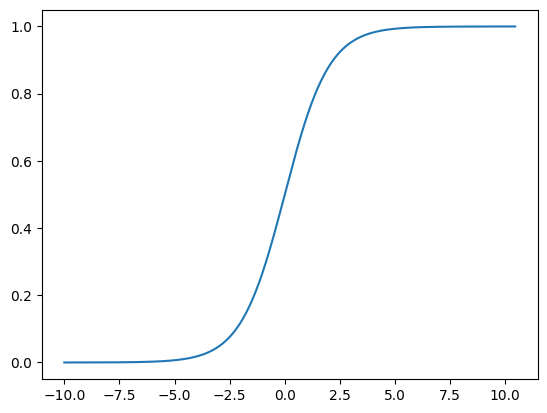
Softmax is a generalization of sigmoid. Sigmoid can be seen as softmax(\( [x, 0] \)). Plotting shows that.
x = np.zeros([410, 2])
x[:, 0] = np.arange(-200, 210) / 20
y = softmax(x)
plt.plot(x[:, 0], y[:, 0])
plt.show()